Summer travel has a way of exposing every weak link in a vehicle.
AC that was “kind of cold” becomes useless in real Okanagan heat. Cooling systems that seemed fine start running hot on long grades between Kelowna and the Coast. Small diesel issues that were easy to dismiss under normal driving become big problems under sustained load. And once you are on the road, two hours south of Kelowna or halfway up the Coquihalla, your options get expensive fast.
BlueStar Mechanical Services provides AC servicing, diesel engine repairs, and exhaust repairs for RVs, motorcoaches, buses, and commercial vehicles in Kelowna. If you have a long trip or a busy season coming up, the best time to book is before the problem forces your hand.
The Okanagan Summer: Why It Punishes Marginal Systems
The Okanagan Valley runs hot from June through September. Kelowna regularly sees temperatures above 35 degrees Celsius in peak summer, and the interior heat is dry and sustained, not the brief cloudy heat of coastal British Columbia.
For motorcoaches and RVs, this matters in specific ways:
- AC systems are running at full capacity for hours at a time, not just occasional bursts
- Diesel engines are working under sustained thermal load, especially on grades
- Cooling systems are dealing with high ambient temperatures and direct sun exposure
- Passengers and travellers notice every degree of cabin discomfort
A system that performed adequately through a mild spring will often fail under the sustained demand of an Okanagan summer. The failure rarely happens at home in your driveway. It happens at the most inconvenient possible moment.
Why AC Problems Show Up Right When You Need It Most
AC systems can degrade slowly and silently. You adapt to a slightly less cold cabin. You notice the fan seems to be running harder. You think “I should get that looked at” and then move on with your day.
Then July arrives and the cabin is 28 degrees with the AC running full blast.
Common AC issues in motorcoaches and RVs include:
- Low refrigerant, almost always the result of a leak somewhere in the system
- Compressor wear: compressors work hard on large vehicles with long run times
- Condenser problems: the condenser can accumulate debris, get physically damaged, or develop leaks
- Fan and airflow issues: a weak fan means reduced heat exchange even when refrigerant levels are correct
- Electrical faults: intermittent performance, cycling issues, and unexpected shutdowns are often electrical in origin
A proper AC service is not just adding refrigerant. It is identifying why the refrigerant level dropped, finding and repairing the leak, and confirming the whole system is operating efficiently. If you only address the symptom (the low refrigerant), you will be back with the same problem later in the season.
Diesel Engine Health: Early Symptoms You Should Not Dismiss
Diesel engines are durable. They also communicate problems early if you are paying attention, and those early signals are almost always cheaper to fix than what they become if ignored.
Early warning signs that your diesel system needs attention:
- Slower starts than usual, especially in the morning
- Power loss under load, noticeable on grades or when the vehicle is loaded
- Rough idle that has developed gradually over recent weeks
- Higher fuel consumption than normal for your route and load
- Smoke changes, including more black smoke on acceleration, white smoke on startup, or blue smoke at any time
- Unusual exhaust smells, particularly a sulphur or burning smell that is new
- Dashboard warning lights related to engine, emissions, or fuel system
Diesel problems on motorcoaches and RVs are particularly worth addressing proactively because repairs on the road are costly and disruptive. A diesel issue that would be a morning shop appointment in Kelowna becomes a multi-day ordeal when it happens in a remote location.
Exhaust System: The Overlooked Link Between Engine and Performance
The exhaust system on a diesel motorcoach or RV is not just a noise management feature. It affects engine performance, emissions compliance, and passenger comfort directly.
Common exhaust issues include:
- Exhaust leaks at joints or flanges, which increase cabin fume risk and reduce back-pressure efficiency
- DPF (diesel particulate filter) blockage or failure, which triggers warning lights and power derate
- EGR (exhaust gas recirculation) valve issues, which cause rough running and increased smoke
- Muffler and pipe corrosion, accelerated by Okanagan winters and road salt
If you have noticed changes in exhaust sound, new soot marks around exhaust joints, or warning lights related to emissions, these are worth addressing before a long trip.
The Pre-Trip Checklist That Prevents a Ruined Trip
 If you are planning extended travel, run this checklist two to three weeks before departure. That timing leaves room for diagnostics, parts, and any follow-up without pressure.
AC and Cabin Comfort
- Confirm consistent cold air at idle and while driving, not just when you first start the vehicle
- Check airflow strength, not just temperature. Reduced flow often indicates a dirty cabin filter or fan issue.
- Watch for cycling issues where the system alternates between cold and ambient without stabilizing
- Listen for unusual noises from the compressor or blower motor
- Note if the system performs differently in high heat versus moderate temperatures
Cooling System and Overheating Prevention
- Check coolant level and condition. Old coolant loses corrosion protection and heat transfer efficiency.
- Inspect hose condition for soft spots, swelling, and clamp tightness
- Confirm radiator fan operation at both speeds if your system has a two-speed fan
- Watch temperature gauge behaviour on hills and under heavy AC load
- Check for coolant leaks under the vehicle after a warmup
Diesel Engine Checks
- Note starting behaviour over several mornings
- Check for any active dashboard warning lights
- Observe acceleration and power delivery on a grade
- Check fuel consumption if you have a record of normal consumption on regular routes
- Look for smoke on hard acceleration
Exhaust and Fumes
- Notice changes in exhaust sound, including new rattles, leaks, or changes in tone
- Look for soot deposits around exhaust joints and connections
- Pay attention to any fumes reaching the cabin, which is particularly important for passenger coaches
Belts and Hoses
- Inspect serpentine belts for cracks, fraying, glazing, or edge wear
- Check coolant hoses for swelling, softness near clamps, or surface cracking
- Inspect any accessible AC lines for chafing or damage
Battery and Electrical System
- Check battery terminals for corrosion
- Test battery condition if the vehicle has been in lighter use during spring
- Confirm all chassis electrical systems are functioning before a long departure
These checks are straightforward. They are the unglamorous preparation that separates trips that go smoothly from trips that get remembered for the wrong reasons.
What Makes Okanagan Travel Different for Motorcoaches and RVs
Travelling through or from the Okanagan creates conditions that stress vehicle systems in specific ways.
Elevation changes. Routes heading west toward the Coast involve significant grade work. Diesel engines operating at sustained load on long grades generate heat differently than highway cruising. Cooling systems that are marginal on flat ground will struggle on a long climb.
Sustained heat. The Okanagan’s summer heat means AC systems may run continuously for hours. Compressors that are slightly underperforming on a cool day will fall short when the ambient temperature is 35 degrees or more.
Distance from service. If your destination is a remote campsite, a charter route through the Kootenays, or a highway crossing to the Coast, you are not close to a service facility. Problems that occur mid-route become significant logistical challenges.
Preparing the vehicle properly before departure is always cheaper and simpler than dealing with a failure on the road.
Why a Coach and RV-Capable Facility Makes Service Easier
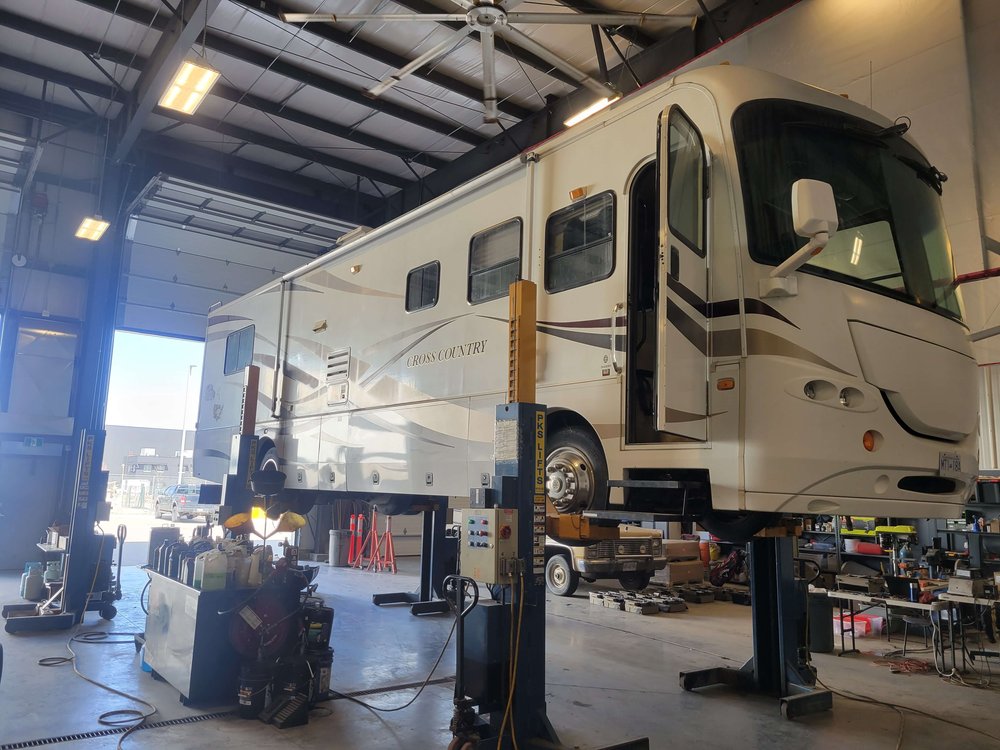 Motorcoaches and large RVs need a facility with the physical space, lift capacity, and technician experience to handle them efficiently. A shop that works primarily on passenger cars and light trucks can technically perform some of this work, but the practical result is usually longer turnaround times, limited diagnostic capability, and scheduling difficulties.
BlueStar’s service facility in Kelowna is built to accommodate large vehicles, including motorcoaches and full-size RVs. That means:
- Proper bay access without constraints
- Technicians familiar with diesel systems, large-vehicle AC, and heavy cooling systems
- Efficient turnaround so your vehicle is ready before your departure date
Booking AC Service or Diesel Repair in Kelowna
If you want to prepare your motorcoach or RV for summer travel, or if you have noticed any of the warning signs described above, contact BlueStar Mechanical Services at 250-765-9020 or [email protected].
Book two to three weeks ahead of any major trip to allow time for diagnostics, parts, and follow-up. Summer fills up fast, and the operators who book early are the ones who leave on schedule.